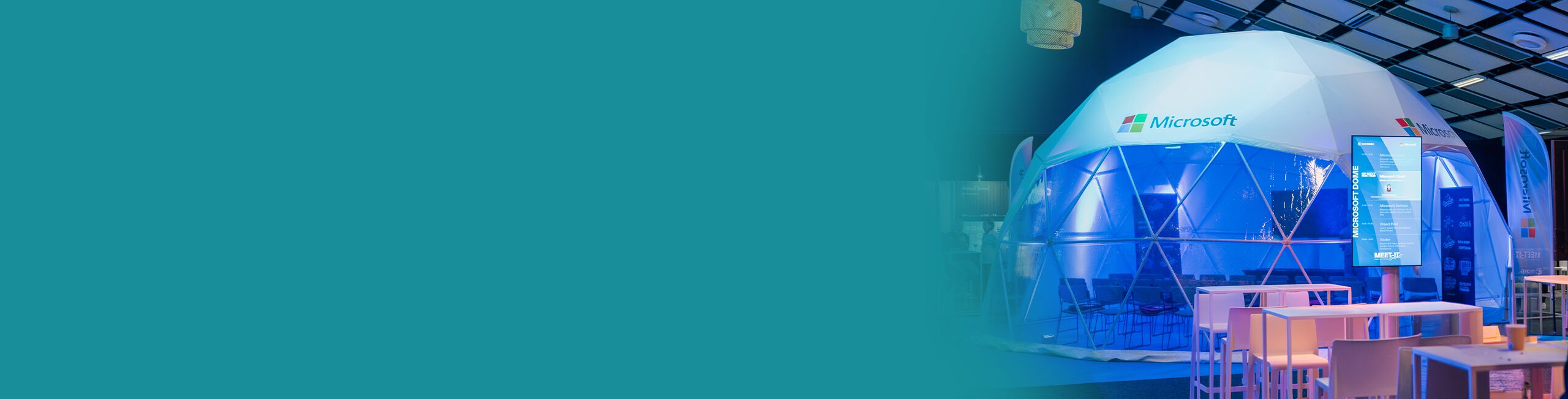
Meet Microsoft Cloud
@ MEET-IT 2025
Get inspired

AI Evolution
Frank explained the journey from simple AI assistants to advanced, autonomous enterprise agents. Copilot integrates with platforms like SharePoint, Jira, and ERP systems, enabling businesses to build, automate, and extend capabilities with low code. The shift from basic assistants to dynamic business partners was emphasized as a key trend.
Copilot is Everywhere
Copilot’s integration across Microsoft 365 apps—Word, Outlook, Excel, PowerPoint, and Teams—was highlighted, showing how Copilot acts as a unified interface for AI-powered productivity and collaboration. Frank showcased the Agent Builder, which allows users to create personal or team agents that orchestrate tasks and knowledge within daily workflows. He demonstrated building an HR agent using SharePoint documents, configuring agent instructions, and adding knowledge sources for instant support.

Hans highlighted the growing importance of digital sovereignty for European organizations. With regulatory complexity at an all-time high and new laws emerging every few days, organizations face increasing challenges in securing data, meeting compliance standards, and navigating geopolitical shifts.
Primacy of the Public Cloud and Evolving Paradigms
The shift to public cloud environments is driving innovation, scalability, and productivity, enabling flexible work and rapid adaptation to market changes. However, concerns about data privacy, regulatory compliance, and sensitive AI workloads prompt many organizations to retain on-premises solutions. Especially as unpredictable geopolitical events and complex regulations continue to shape IT strategies.
Microsoft’s European Digital Commitments
Copilot’s integMicrosoft has made five key commitments to Europe: building a broad AI and cloud ecosystem, upholding digital resilience, protecting data privacy, defending cybersecurity, and strengthening economic competitiveness. These commitments are reflected in the expansion of Microsoft’s Sovereign Cloud portfolio, offering organizations tailored solutions for data residency, compliance, and operational sovereignty.


Azure Frameworks: Innovate with Confidence
The speakers emphasized the importance of innovation and adaptability in IT. It introduces the Microsoft Azure Well-Architected Framework as a foundation for building cloud solutions that are secure, efficient, and reliable, empowering organizations to innovate confidently for long-term success.
Well-Architected Cloud Workloads
Success in IT isn’t determined by strength or intelligence. It’s about the ability to adapt. As mentioned by Frank and Jelco, flexibility and responsiveness are crucial for thriving in a constantly changing environment. By operating well-architected workloads, organizations can gain real business benefits: they can control costs, boost security, streamline operations, and improve overall performance. Ignoring best practices can lead to serious issues like financial loss and damage to reputation. The Azure Well-Architected Framework offers practical guidance to help organizations avoid these risks and build resilient, efficient cloud solutions.
Shared Responsibility and Best Practice
Building optimized workloads is presented as a shared responsibility between Microsoft and its customers. The framework’s five pillars; cost optimization, operational excellence, performance efficiency, reliability, and security, are explained as essential for achieving business objectives and operationalizing cloud solutions.
Would you like to learn more?
For more detailed information and to explore the full range of Microsoft’s solutions, we invite you to download the presentations or contact TD SYNNEX for further assistance. Our team is ready to help you leverage AI to transform your business and achieve your goals.
Ready for the next step? Contact us!